18 questions to develop
a successful product.

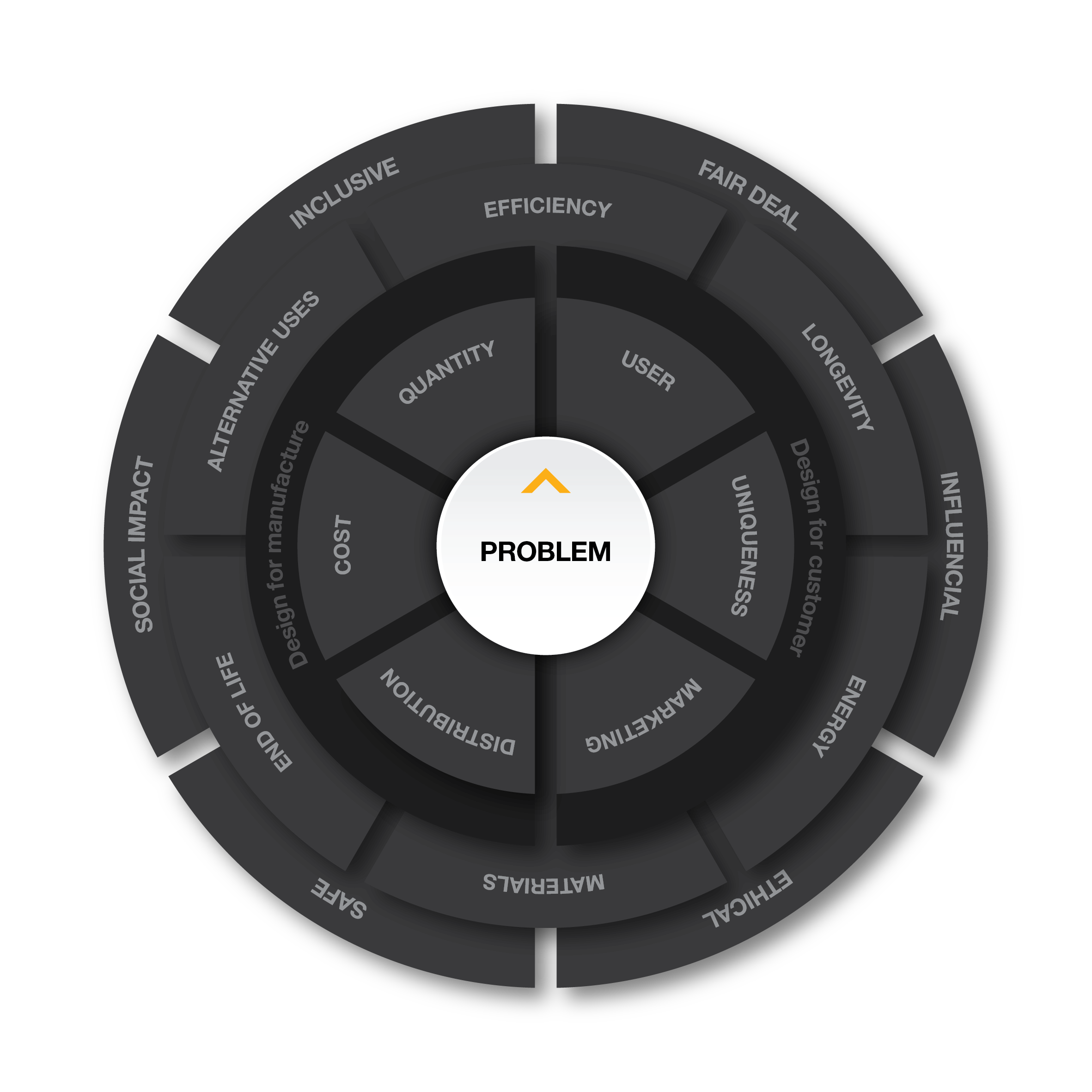
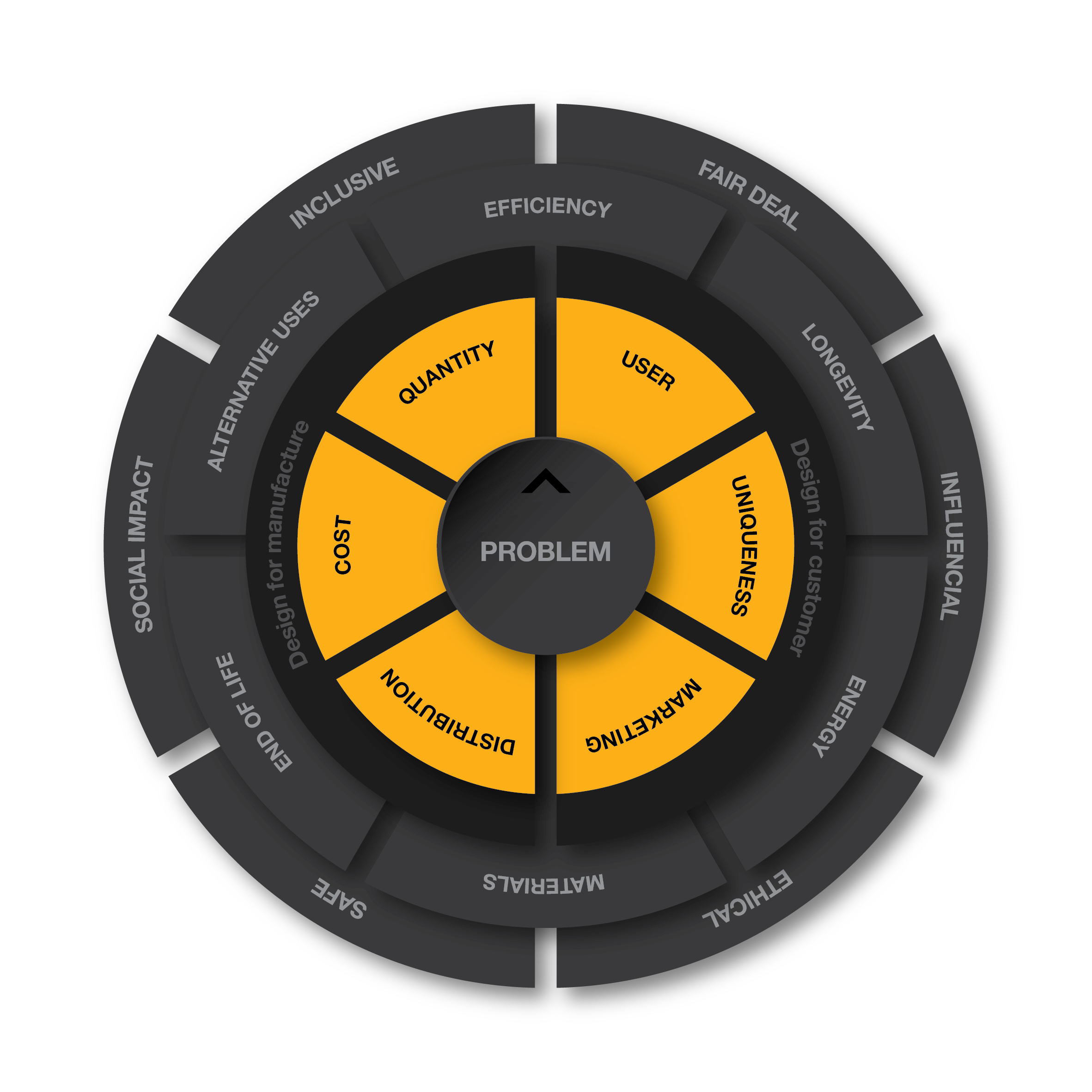
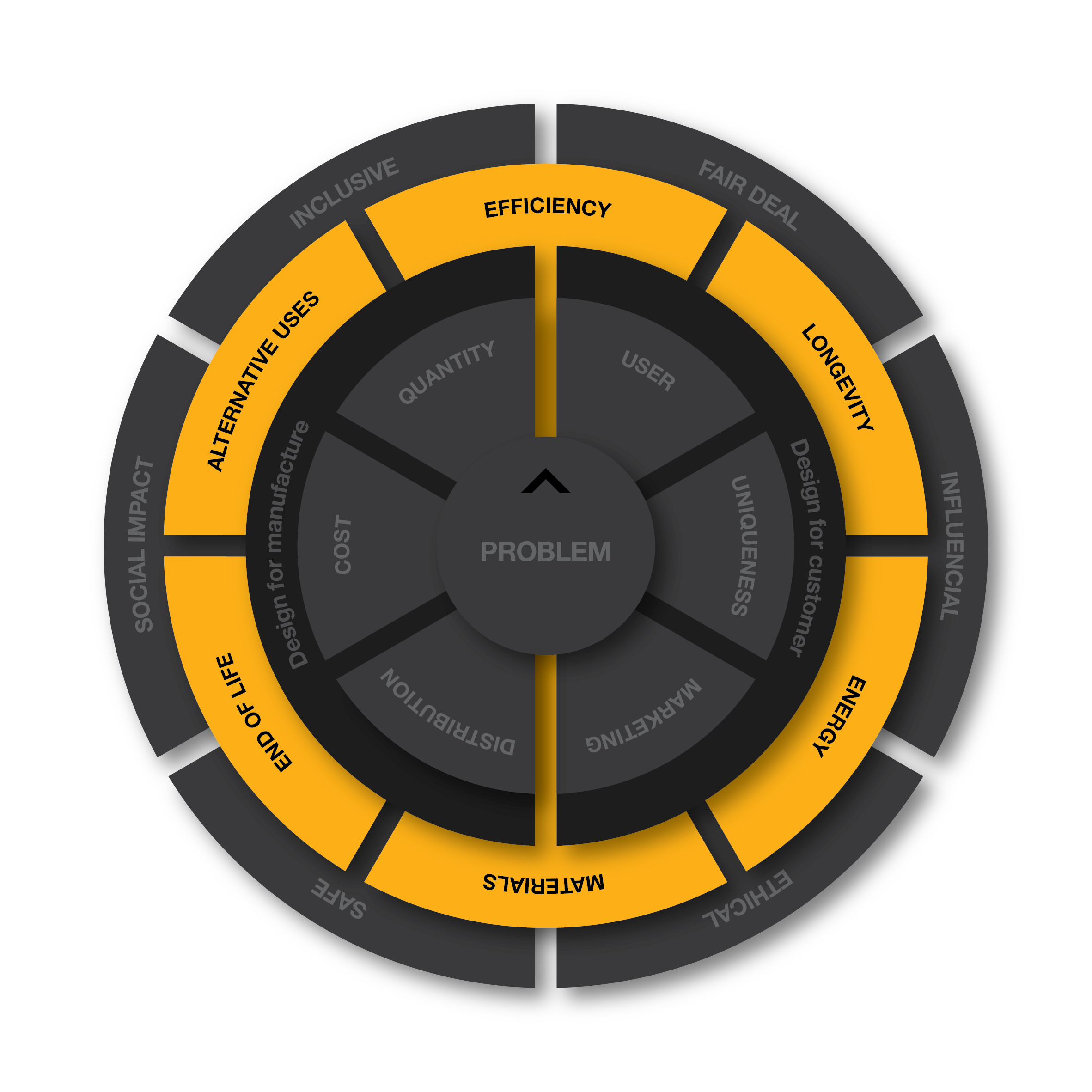
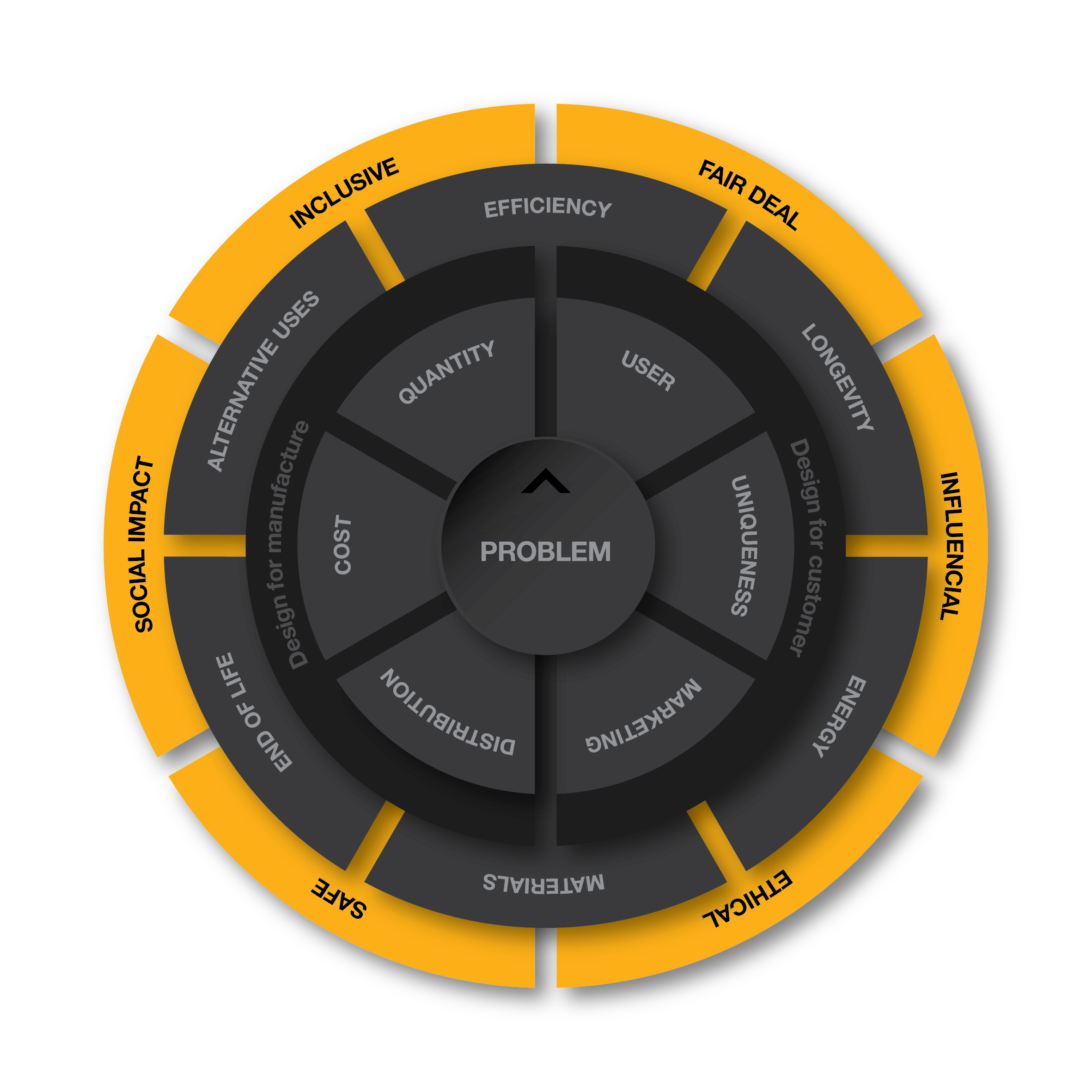
The Design Compass
Layer 4
Layer 3
Layer 2
Layer 2
Layer 1

Original

Viable

Sustainable

Ethical

Original
Viable
Sustainable
Ethical
1.
Start with the problem
2.
Design for market:
Start with the problem
3.
Environmentally sustainable:
Optimise your ideas to care for the environment.
4.
Socially responsible:
Forecast your idea’s impact on people.

The Design Compass is an essential tool
for anyone driving innovation and best
practice in product development.

Learn

Learn

Discover how to develop a viable, sustainable and ethical product.
Explore the compass: a segmented framework to guide your product development journey with the 18 questions you need to answer to create a successful product.  A database of articles, expert resources and case studies that are continually expanded and updated.
Generate

Generate

Create cross-segment challenges to test your idea.
These can be used to improve your existing ideas or to spark new ones by combining multiple goals.
Benchmark

Benchmark

Assess the strength of your idea against the market.
Easily compare your idea’s performance across different segments to gain an overall picture of your strengths and weaknesses with suggestions on how to improve.
Expert chat

Expert chat

Talk with one of our AI experts about your design-realted queries.
Trained on our curated database of resources and tailored for the development process. Unlike Regular AI this is built for purpose, with a focus on real-world practicality.
Projects

Projects

Discuss your project in detail with our
Design Planning AI.

Share multiple projects.

Switch between segments and discussions.

Generate a scoping document.

The Design Planning AI will guide you through the compass questions, offer information sourced from the compass, and highlight risks.
Upload information and discuss multiple projects, each with their own compass showing their progress.

Projects will automatically create and update a document containing everything you need to communicate your idea to a 3rd party such as an investor or a designer. This includes a summary of your idea, risks and opportunities, brief, and sustainable and ethical potential.

Our AI explained

Focused on design and development
Delivering detailed on-topic answers, even if you aren’t sure of the right questions to ask.
Designed to challenge you
Our AI is not sycophantic, it is sympathetic but it will not hesitate to list the risks, keeping you fully informed.
Providing ethical and verified information
Trained on our curated knowledge database.
Minimising functionality and efficiency
Powered by multiple LLM models with the ability to switch between them as needed so that you can be sure you are getting the best answer.
Private
Unlike many AI-powered platforms we do not use your conversations as training data.
Pushing sustainability
We always strive to use the most eco-friendly technology available, providing you with an approximation of the AI’s energy use and carbon emissions as you chat.
Powering designers for the green transition by 2030
The Design Compass incorporates the Design Council’s Skills for Planet Blueprint. Embedded throughout the Compass, these skills strengthen and support professional development in sustainable design practice.

Data security

The Design Compass
was built with privacy
as a foundational
principle, not an
afterthought.

Full encryption
All AI conversations are protected using AES–256-CBC encryption, trusted by governments and financial institutions worldwide.
No administrative backdoors
There are no master keys, no support access modes, and no exceptions.  
Selective deletion
There are no master keys, no support access modes, and no exceptions.
Complete data removal
There are no master keys, no support access modes, and no exceptions.
Design Compass
“The Design Compass captures the complexity, compromises and tensions that are constantly spinning around the mind of an experienced product designer. This simplified the process for students and also demonstrated the level of thinking required for each different aspect and helped the students see how much is required of a product designer.”
Rebecca Falcon, Course Leader at Chester University

Basic

  • Evaluate
  • Generate
  • Benchmark
Think

For individuals or teams starting out in product design who want to explore the basics of marketable, sustainable, and responsible design without financial commitment.

Advanced

  • Evaluate
  • Generate
  • Benchmark
  • +Expert chat

Learn
For designers or teams who need more in-depth guidance on balancing commercial viability with sustainability and social responsibility in their product designs.

Pro

  • Evaluate
  • Generate
  • Benchmark
  • +Expert chat
  • +Projects
Develop
For businesses or startups looking to develop new products that are commercially viable while minimising negative impacts on people and planet.

Ultra

  • Evaluate
  • Generate
  • Benchmark
  • +Expert chat
  • +Projects
  • +…
Innovate
For larger organisations or enterprises aiming to integrate sustainability-focused practices into their business operations and product development processes at scale.

Our sustainability explained

It is important to us that we acknowledge our own impact. This online tool uses energy to run: the servers it is hosted on require power and cooling. Whilst we have tried to be efficient with our resources and seek sustainable options wherever possible, this still has a negative impact on the planet. 

Product development and production is highly resource intensive. Whilst the exact numbers are hard to verify, the manufacturing sector is predicted to account for around one-fifth of global carbon emissions and 54% of the world’s energy usage. It uses not only energy, but materials, many non-renewable, that can end up polluting our water and filling our landfills. 
 
If the knowledge and guidance provided by this tool allows even one product to be produced more sustainably, we will be producing a net positive for people and planet.   

We have added a carbon tracker, which calculates approximately how much energy and carbon dioxide has been produced by your use of the Design Compass. It will also show you equivalents so you can understand what that means in real terms.

Collaborators

The Design Compass has evolved through partnerships with professional product designers and universities, integrating academic insights with practical industry experience. We welcome collaboration from industry professionals and academics working in this space, believing that collective expertise can further advance responsible design practices. The Design Compass represents our ongoing commitment to innovation that balances commercial success with environmental and social responsibility.